Mostly a note/reminder for myself.
I was not operating under my current personal rules from the start; after going through various experiences, this is the approach I am trying now.
It is kind of like a secret sauce, so I will update this again whenever it changes.
It may or may not be useful as a reference.
Rules
- Do not let my ability to add funds drop
- Keep half of my assets in “completely free cash”
- Put the long-term bucket on the NISA side
- Do not rush into margin trades. Do not touch markets I do not understand
Asset Management and Overall Rules
Maintain a steady ability to add funds
Every month, I always put at least a fixed amount into investments.
Because with stocks, in the end, whatever you do, the ability to add funds matters.
I have a serious case of “that would be wasteful” syndrome, so I am the type who does not buy things unless I am truly forced to.
As a result, without really thinking about it, I was able to save money, and that also became the initial capital when I started NISA. So I recommend catching the waste-not bug. (I still use a tracksuit I bought in junior high as loungewear.)
Half of assets in “completely free cash”
Especially if you trade on margin, your mental state breaks when the market gets rough while your cash is thin.
Once you get hit with a margin call, you understand this: if you do not have cash you can deposit, you are truly stuck.
So, also to avoid margin calls, I am strict about keeping half of my assets as completely free cash.
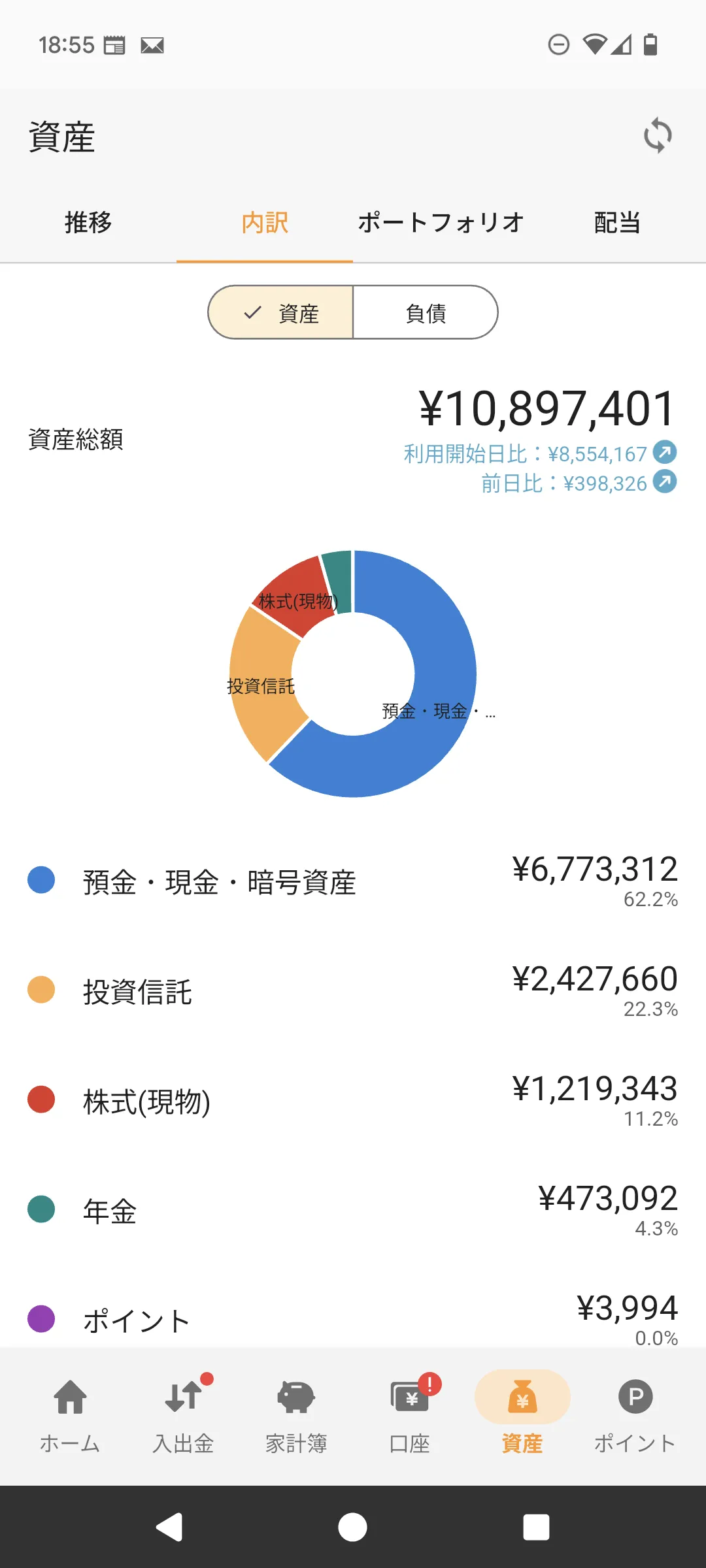
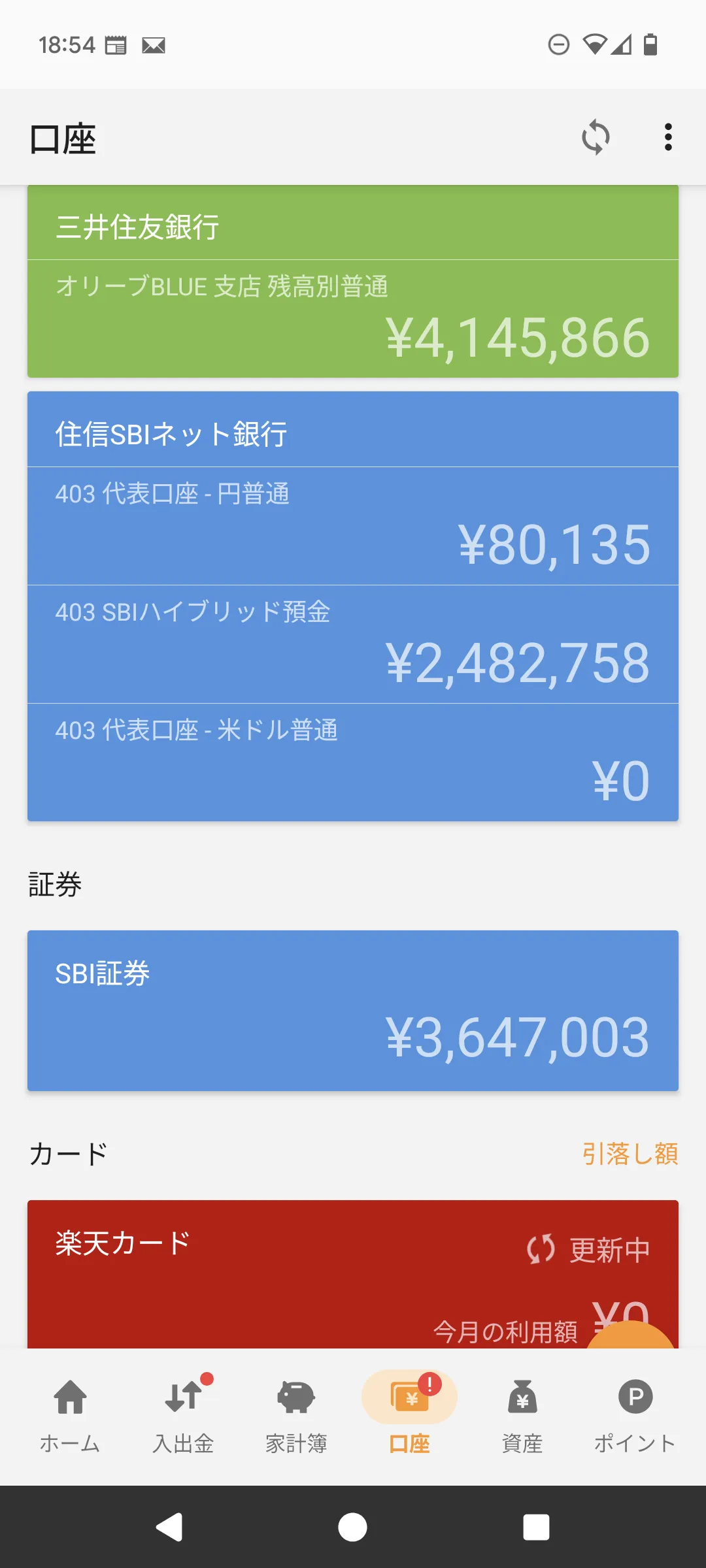
As an example, this is the approximate breakdown of my assets as of 2025/8/25.
- Crypto assets: a little under 100,000 yen (fluctuates daily)
- Cash: about 4.10 million yen (completely free)
- Cash: about 2.40 million yen (for cash stock investing and margin capacity)
- Corporate DC plan: about 500,000 yen
- Stocks (cash/NISA): about 1.20 million yen
- Investment trusts (NISA): about 2.40 million yen
- Stocks (margin): varies by position
The ideal is 50%, and because my cash ratio is slightly low, I always keep in mind not to let it get any worse.
My corporate DC plan is in Tsumitate U.S. Equity
I make monthly contributions to Tsumitate U.S. Equity (S&P 500).
The products you can choose probably differ by company, but I think it is better to choose a decent investment product rather than leaving it as cash.
Put long-term assets on the “NISA side”
For safety, I put more than half of my financial assets, including the cash kept for margin capacity, into NISA.
The key point is that holdings in a NISA account do not become collateral for margin trading under the system.
Using this lets me satisfy my desire to invest assets while not physically increasing my margin capacity.
I have been burned badly by margin trading, so I use this as a physical restraint.
If I have money that can be used as margin capacity, the devil in my heart comes out.
Investment Trust Rules (NISA)
Only a monthly 100,000 yen accumulation.
The reason is that the upper limit for credit-card investment plans is 100,000 yen per month.
Points only accrue on credit-card payments, so I do not feel much need to add even more in cash.
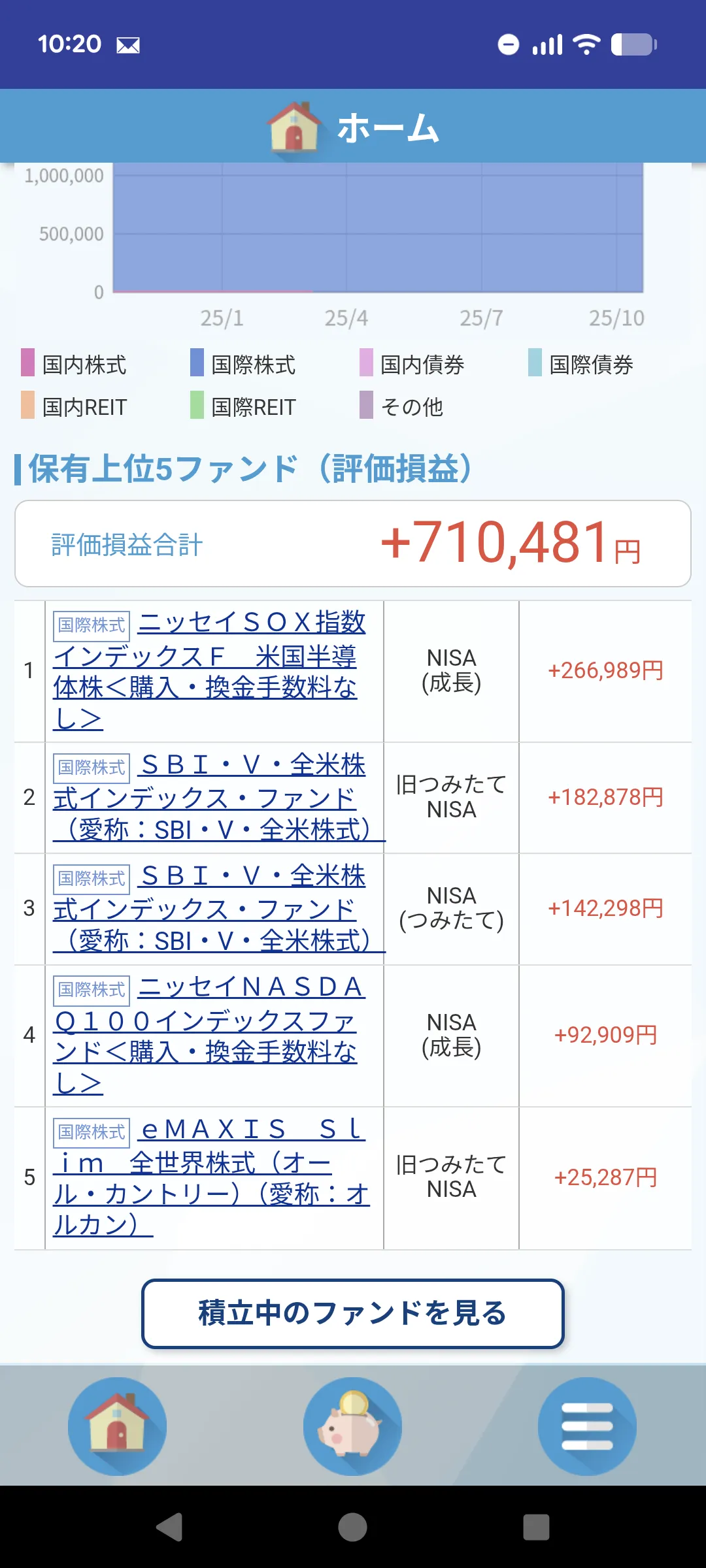
The current breakdown looks like this.
- Nissay SOX Index Fund: 50,000 yen
- SBI Total U.S. Stock Market Index Fund: 30,000 yen
- Nissay NASDAQ100 Index Fund: 20,000 yen
I work at an IT company, and since around the end of 2022 when ChatGPT was released, I strongly felt that “this will definitely be a game changer.”
I am overweight SOX because I judged that, along with the spread of AI, the semiconductor field is highly likely to grow over a span of several years.
On the other hand, for individual stocks I buy Japanese stocks, so I balance regional diversification (Japan and the U.S.) there.
Cash Stock Trading Rules (Mostly NISA)
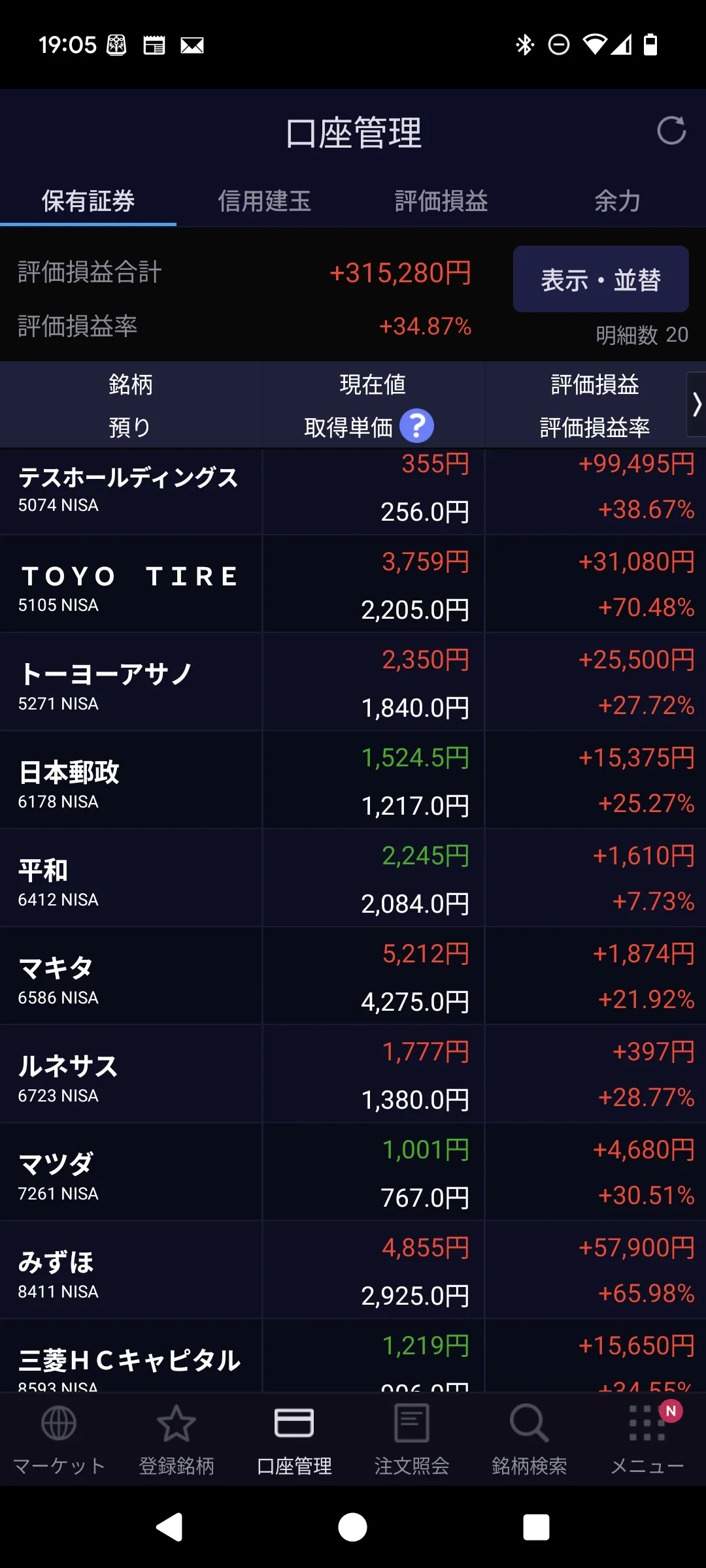
I also basically buy individual stocks through NISA.
My feeling is roughly “better than leaving the money in the bank…,” and I do not buy them on the premise that I will sell in the short to medium term.
When to buy
I only buy when I happen to find a stock that I can expect good things from over the long term and where the timing is also good.
As a rough standard, only stocks that fit the following.
- The drop looks like it came from an external factor, like an accident
- The service is necessary for daily life, and demand is unlikely to disappear
- It pays a dividend
As an example of the above, when the market was rough due to concerns such as Trump tariffs, I judged that “this drop looks accident-like” and bought a batch at once.
Margin Trading Rules (Fundamentals-Leaning Swing Trading)
What I do is not day trading, but fundamentals-leaning swing trading.
Absolutely, positively never rush into a position
This may be the most important thing.
The moment “I want to make money quickly” turns into “I should take a position quickly,” I basically lose.
The more interested I get, the more I want to touch it.
Watching YouTube, starting to follow information about a specific stock, and so on.
My personal rules are these.
- Do not touch it if the rationale is weak
- Watch from the sidelines in markets I do not really understand
- Thoroughly stick to fundamentals-leaning swing trading, not day trading
Check margin balances at a minimum
- Margin long balance / margin short balance
- Short balances held by short-selling institutions
Well, it is obvious, but if margin longs have piled up, the stock has a harder time rising.
Also, whether it looks like the stock is being targeted by institutional short sellers is very important.
Right now, I think the easiest approach is to ride along with those moves and win small.
Only touch companies where my information sphere is strong
To raise my win rate in swing trading, in the end I need to understand the company and industry.
It is easier to narrow the industries I touch to one if possible, and the companies to about two or three at most.
I am in an environment where I naturally get information about games, IT, and VTubers through work and social media, and I am interested in them in the first place, so they are easy for me to follow.
Right now, within that area, I am focusing on VTuber-related companies and trading them.
Use social media for the “speed of catalysts”
With VTuber-related companies, for swings over a few days to a few weeks, I feel from actual trading experience that recent company developments are often reflected in stock prices.
I got the impression that there are many situations where prices move along with events such as live events, pop-up stores, graduations or retirements, and controversies.
(Things like support buying and disappointment selling tend to happen.)
Margin Trading Record (Summary)
This is a note for myself, but I think it can also serve as evidence.
- Period: 2025/04/03 to 2025/12/02
- Positions: 7 (win rate 7/7)
- Realized P/L: +437,076 yen
- Fees and expenses: -5,514 yen
- Net P/L: +431,562 yen
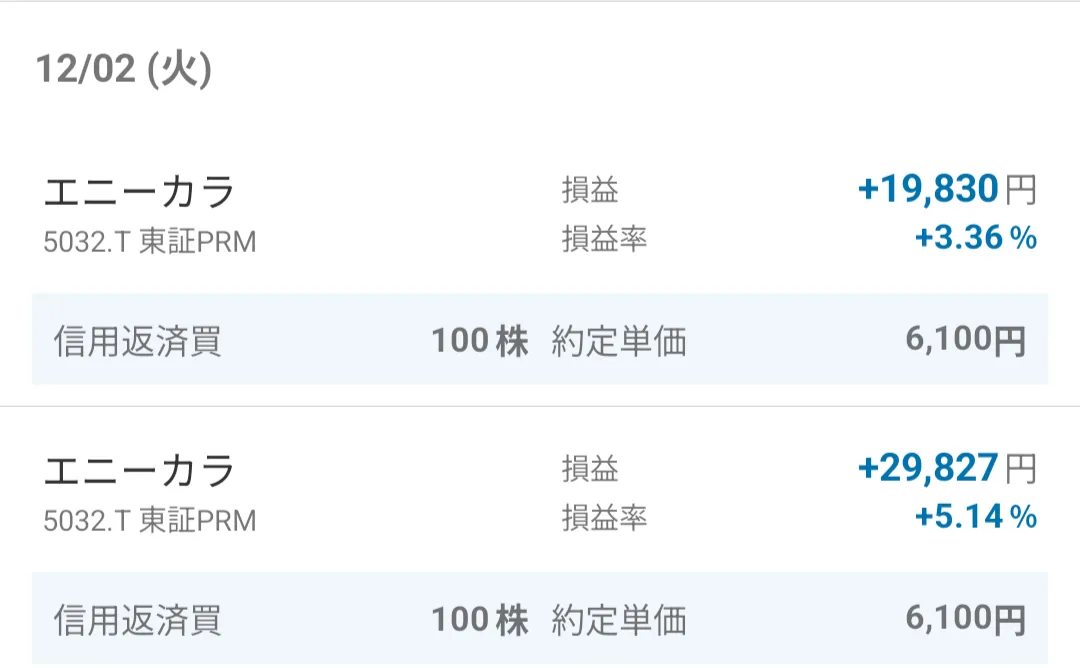
2025/11/21 → 2025/12/02|Short|ANYCOLOR|200 shares|Net +49,314 yen
- New position: 2025/11/21|200 shares|average execution price 6,350 yen
- Close: 2025/12/02|200 shares|average execution price 6,100 yen
- Realized P/L: +49,657 yen
- Fees and expenses: -343 yen
- Net P/L: +49,314 yen

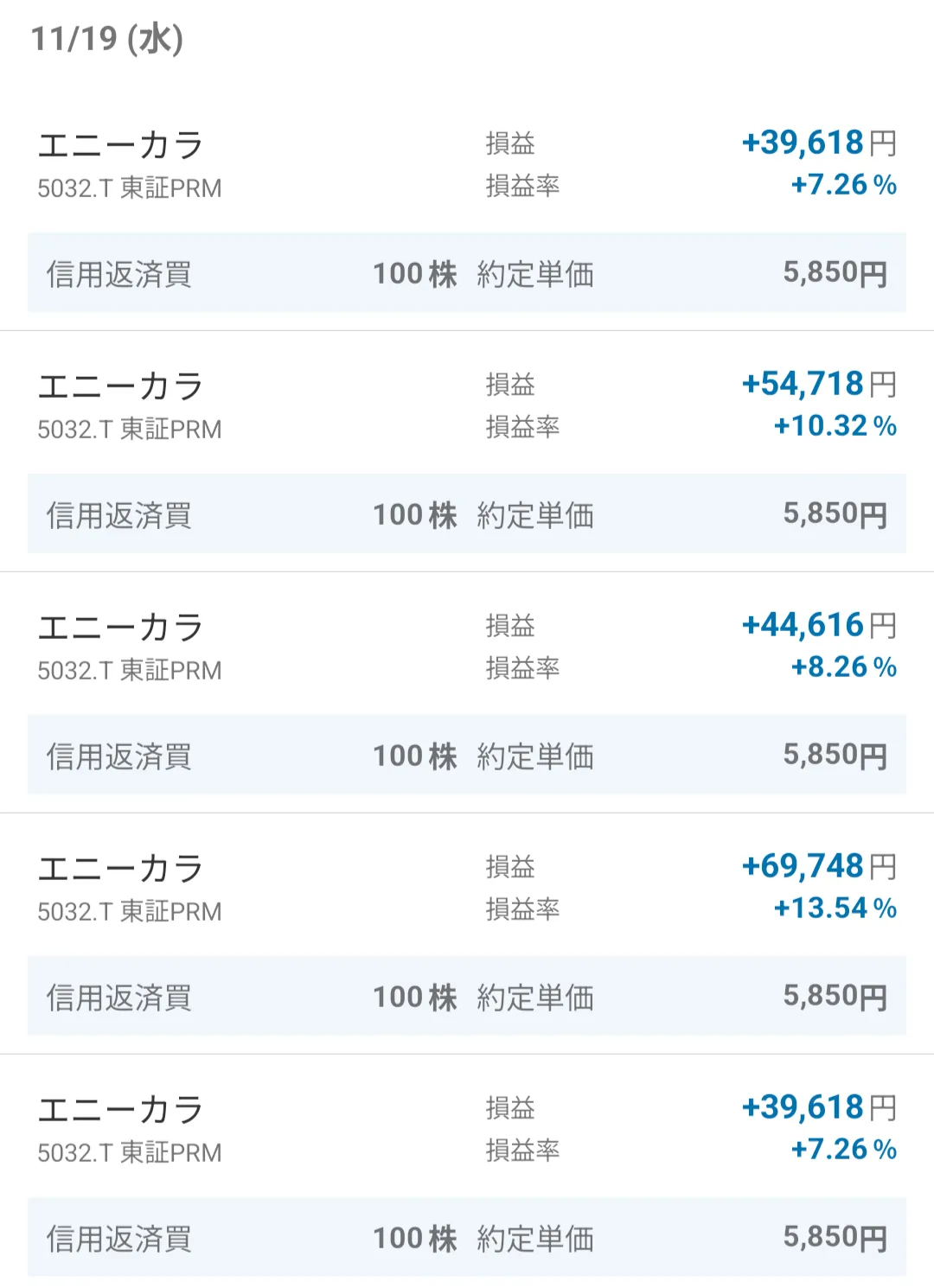
2025/11/05 → 2025/11/19|Short|ANYCOLOR|500 shares|Net +246,636 yen
- New position: 2025/11/05|300 shares|average execution price 6,266.67 yen
- Added short: 2025/11/10|100 shares|average execution price 6,400 yen
- Added short: 2025/11/11|100 shares|average execution price 6,550 yen
- Close: 2025/11/19|500 shares|average execution price 5,850 yen
- Realized P/L: +248,318 yen
- Fees and expenses: -1,682 yen
- Net P/L: +246,636 yen

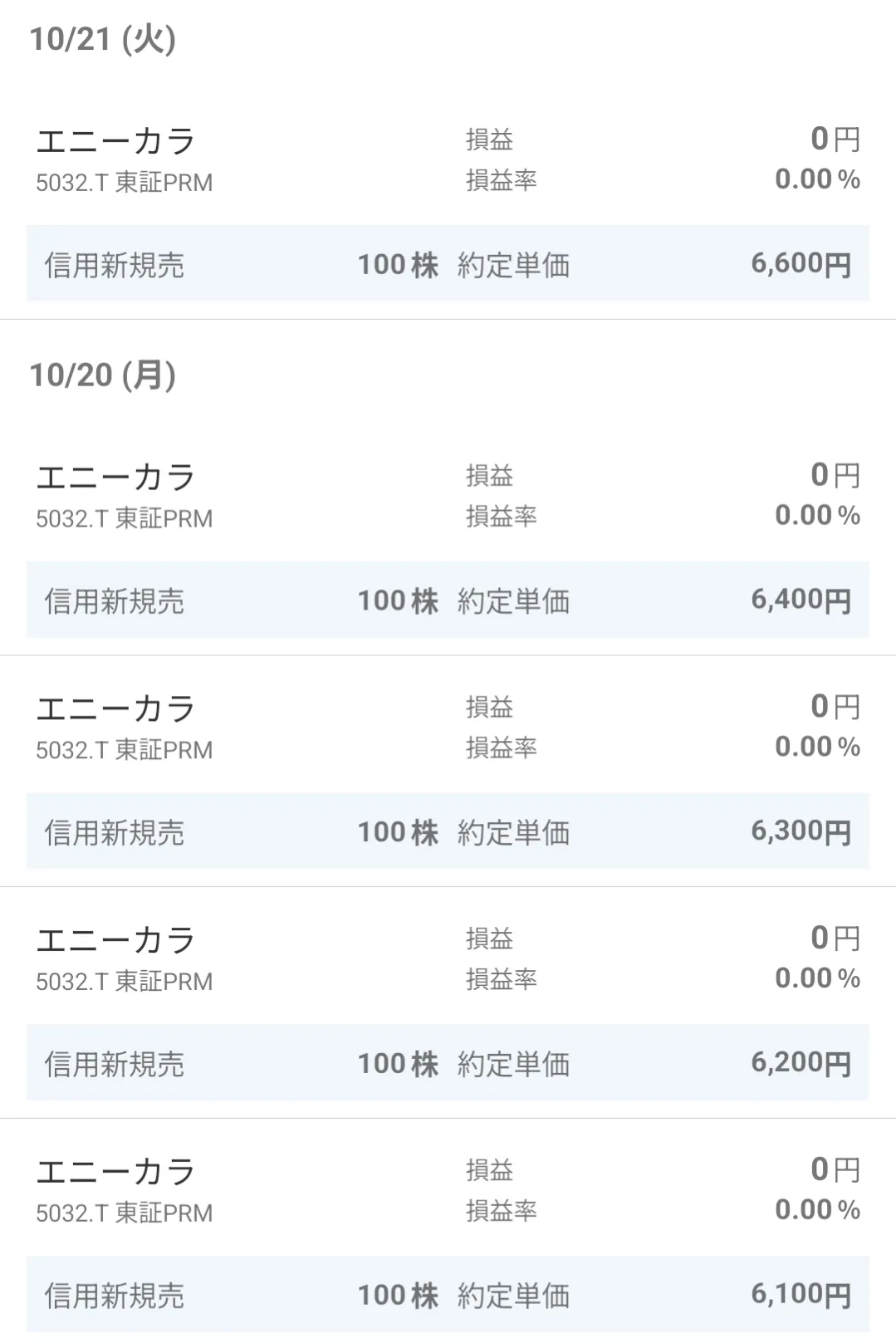
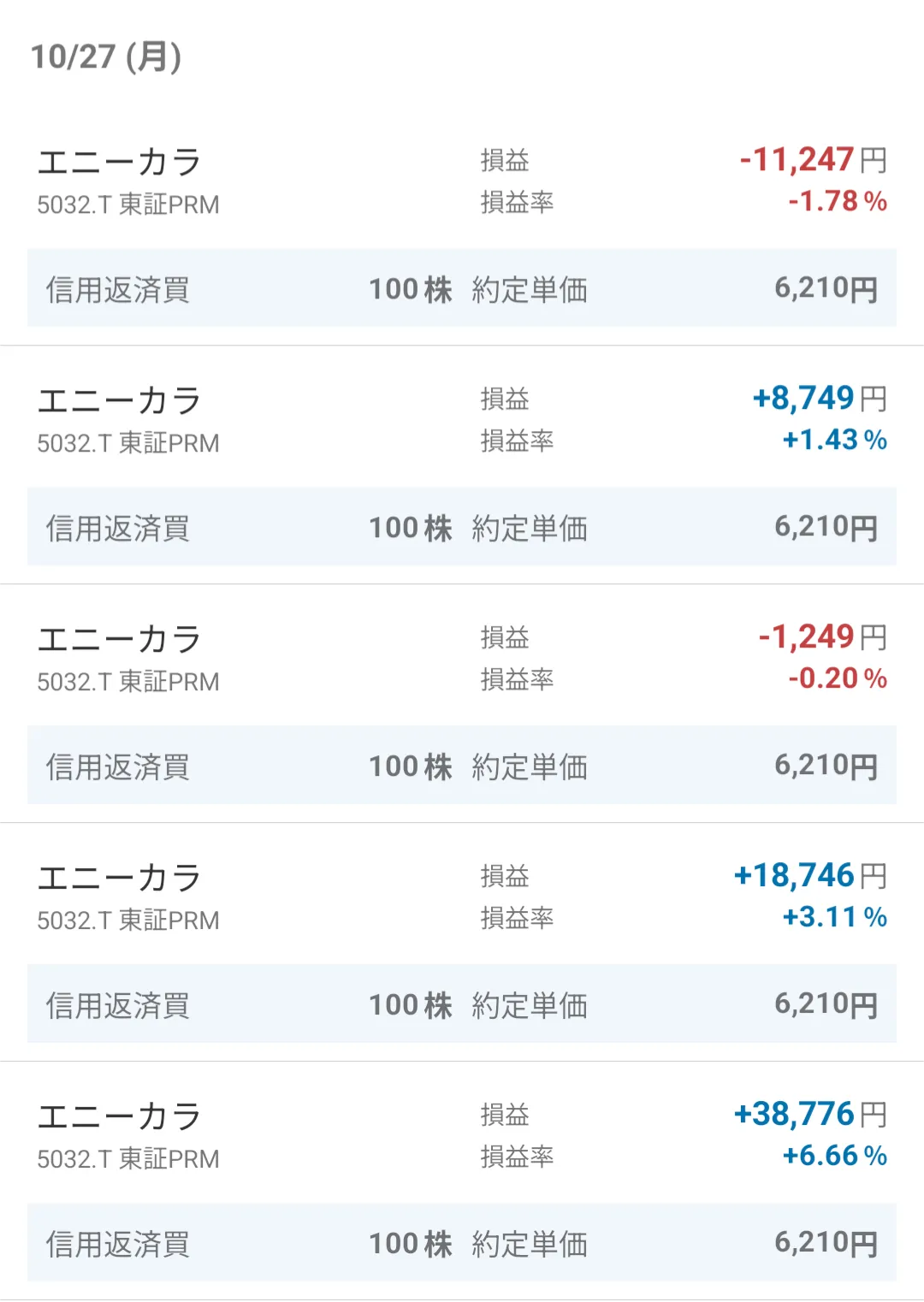
2025/10/20 → 2025/10/27|Short|ANYCOLOR|500 shares|Net +52,550 yen
- New position: 2025/10/20|400 shares|average execution price 6,250 yen
- Added short: 2025/10/21|100 shares|average execution price 6,600 yen
- Close: 2025/10/27|500 shares|average execution price 6,210 yen
- Realized P/L: +53,775 yen
- Fees and expenses: -1,225 yen
- Net P/L: +52,550 yen
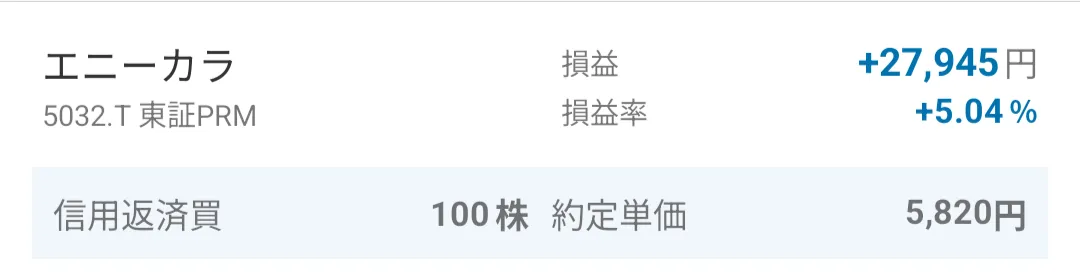
2025/10/09 → 2025/10/14|Short|ANYCOLOR|100 shares|Net +27,890 yen
- New position: 2025/10/09|100 shares|average execution price 6,100 yen
- Close: 2025/10/14|100 shares|average execution price 5,820 yen
- Realized P/L: +27,945 yen
- Fees and expenses: -55 yen
- Net P/L: +27,890 yen

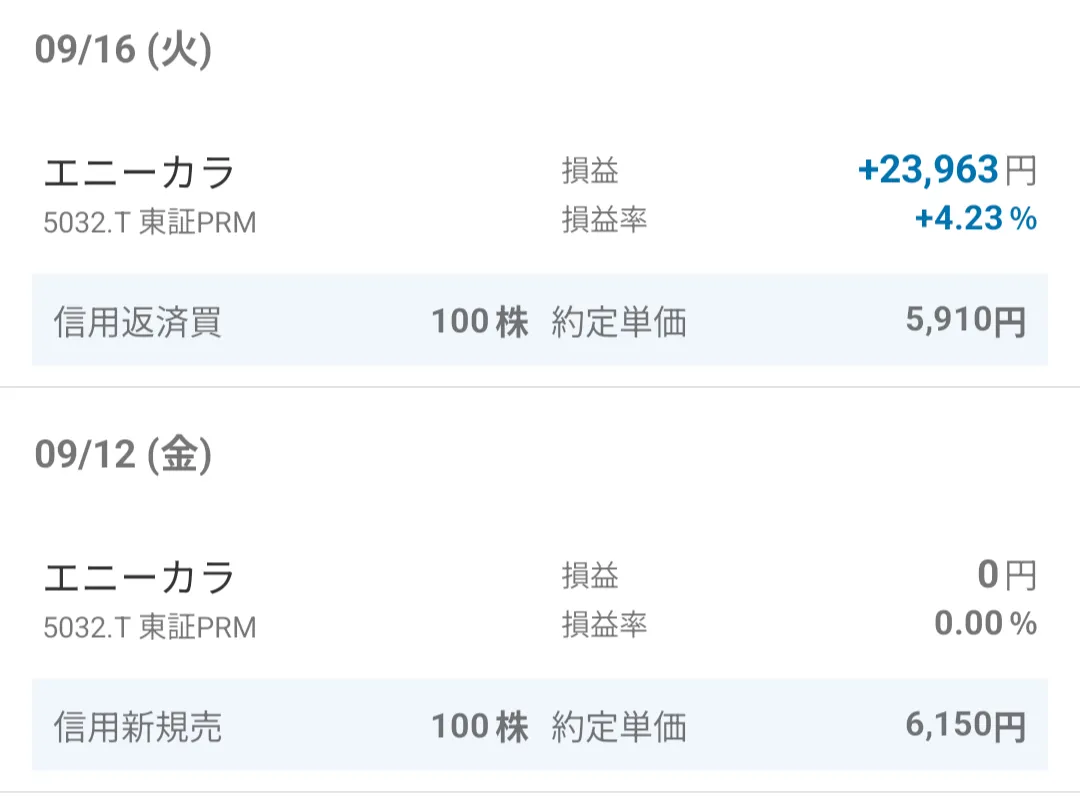
2025/09/12 → 2025/09/16|Short|ANYCOLOR|100 shares|Net +23,926 yen
- New position: 2025/09/12|100 shares|execution price 6,150 yen
- Close: 2025/09/16|100 shares|execution price 5,910 yen
- Realized P/L: +23,963 yen
- Fees and expenses: -37 yen
- Net P/L: +23,926 yen
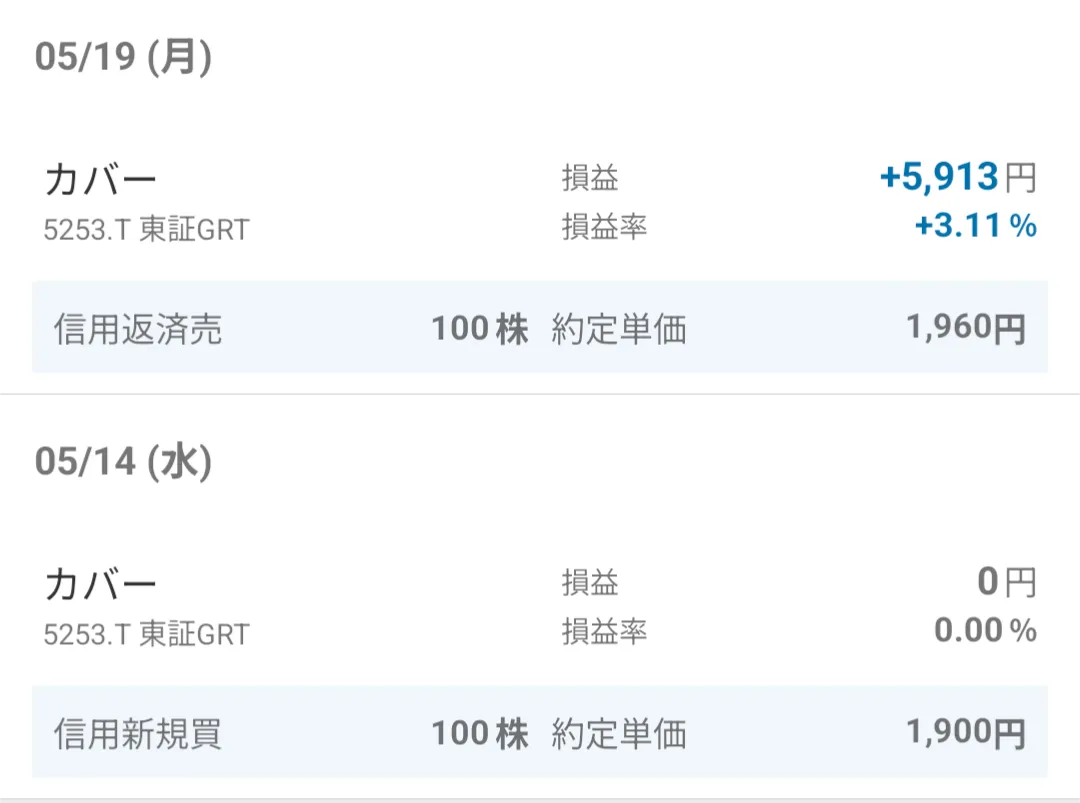
2025/05/14 → 2025/05/19|Long|COVER Corp.|100 shares|Net +5,826 yen
- New position: 2025/05/14|100 shares|execution price 1,900 yen
- Close: 2025/05/19|100 shares|execution price 1,960 yen
- Realized P/L: +5,913 yen
- Fees and expenses: -87 yen
- Net P/L: +5,826 yen
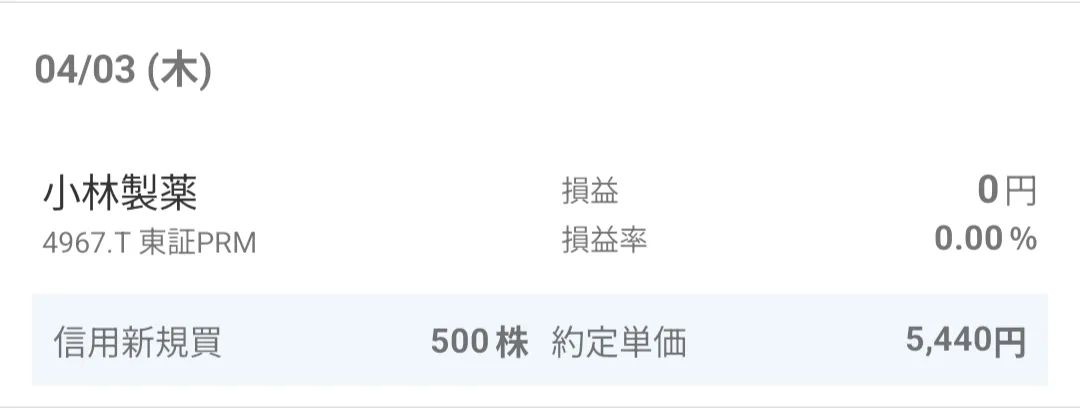
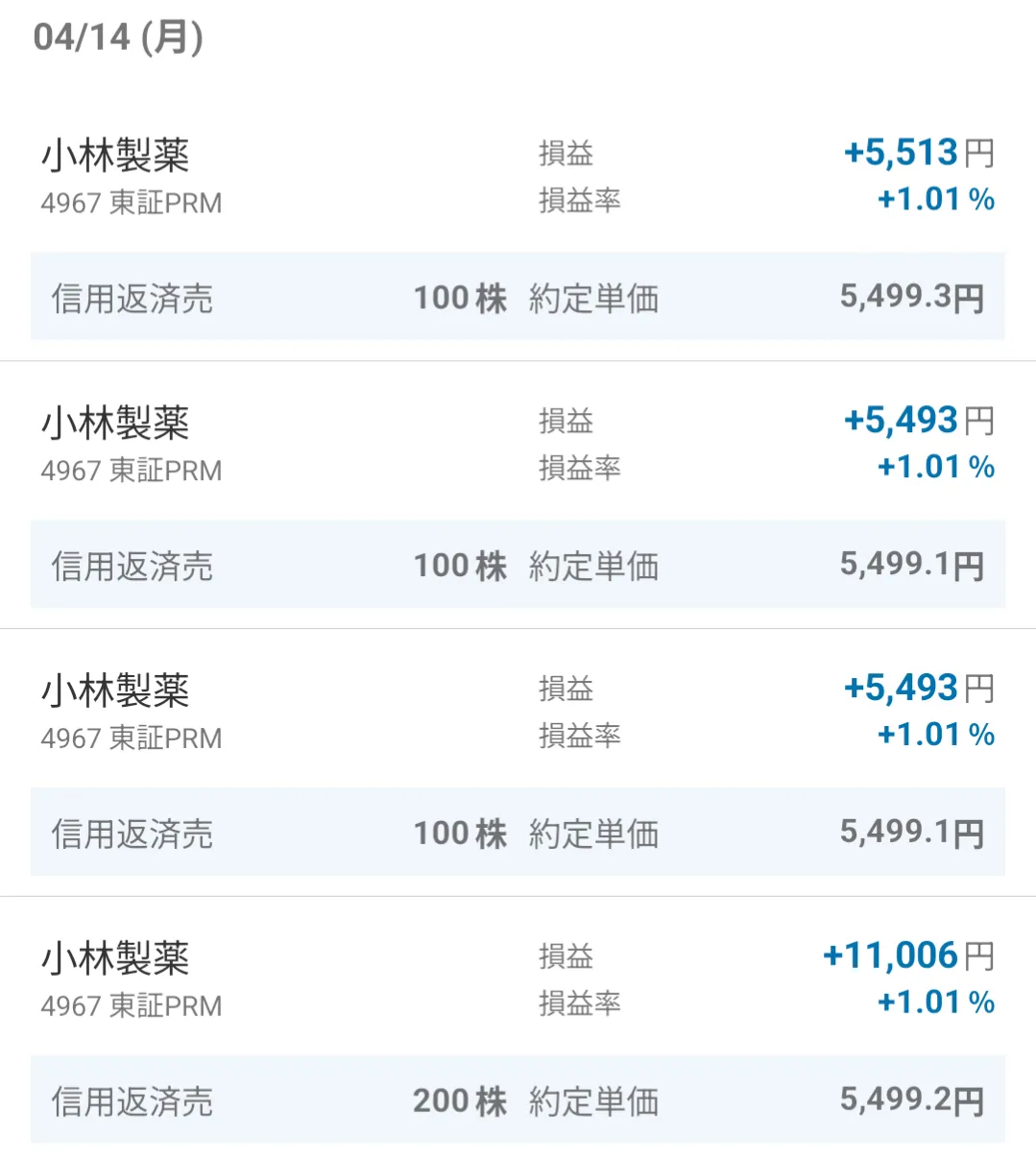
2025/04/03 → 2025/04/14|Long|Kobayashi Pharmaceutical|500 shares|Net +25,420 yen
- New position: 2025/04/03|500 shares|execution price 5,440 yen
- Close: 2025/04/14|500 shares|average execution price 5,499.2 yen
- Realized P/L: +27,505 yen
- Fees and expenses: -2,085 yen
- Net P/L: +25,420 yen


![[VALORANT] A Seriously Top-Tier Aim Training Method](https://blog.devkey.jp/en/posts/valorant-aim-training/index.png)